





Parenthood & nesting // From inherited patterns to conscious caregiving
Raising Children in the Age of Algorithms
Parenting has always shaped a child's world. Today, it shares that role with algorithms engineered to compete for their attention, identity, and sense of belonging.
Let's face this challenge together!
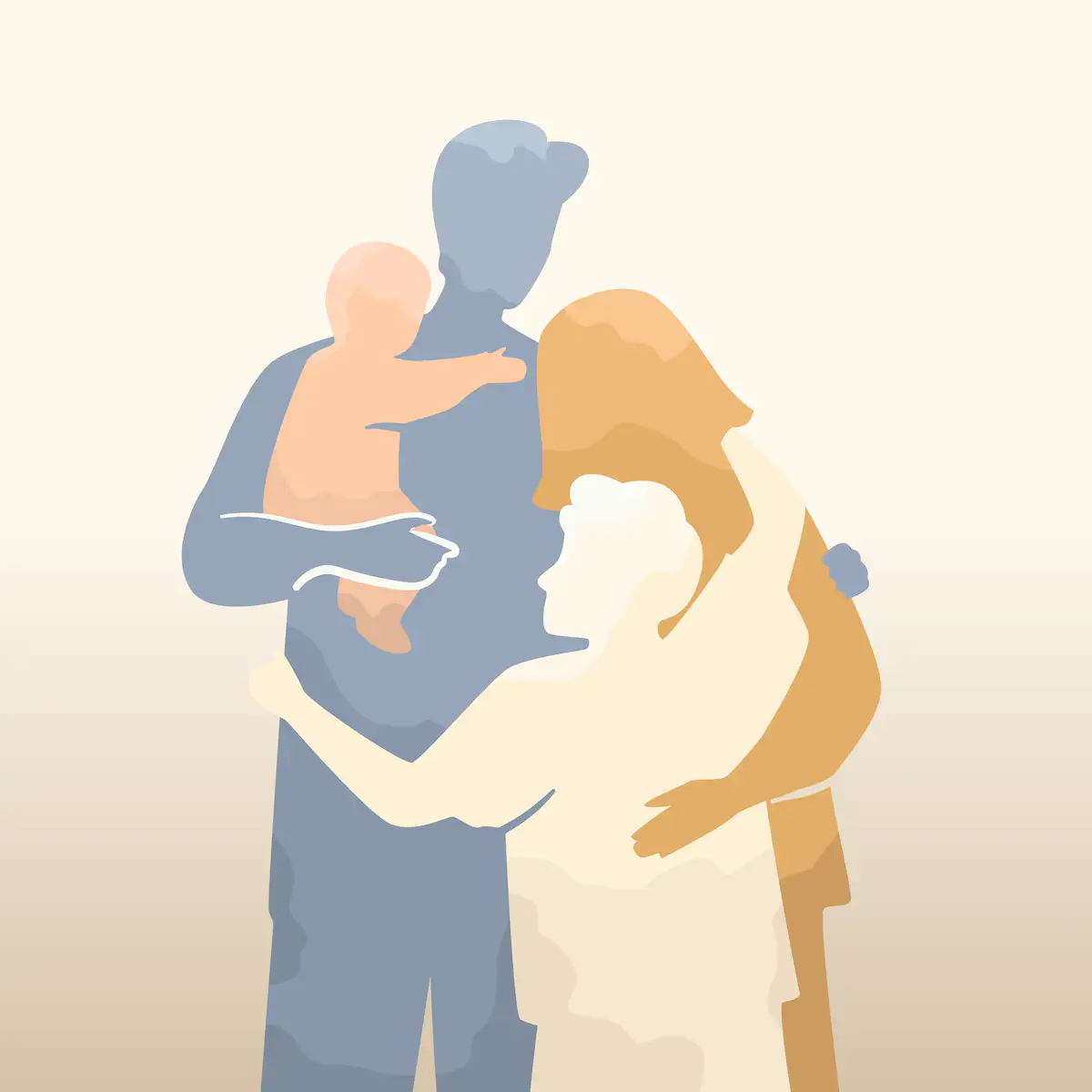
The World your child is growing up in
The Impact of the Environment on Child Development
Developmental science is unambiguous about what children need to become healthy, regulated, genuinely connected human beings: responsive relationships, warmth and attunement, unhurried self-directed play, nature, community, together with adults who see them fully and hold them consistently, so their nervous systems can develop without chronic dysregulation.
These biological requirements, represent the evolved nest our species refined over hundreds of thousands of years precisely because children cannot develop well without them.
The research of Dr. Darcia Narvaez makes one thing clear: we are raising children in conditions increasingly misaligned with what they are designed to need. The pace, the pressure, the fragmentation of community, the replacement of unhurried presence with constant stimulation, all of it opens a gap between what children need and what modern life provides.
And into that gap, the algorithm moves.
Social media platforms are not neutral tools. They are architectures of engagement, built by teams of engineers and behavioral scientists to be as compelling and as hard to put down as possible. The same dopamine-driven loops that make adults reach compulsively for their phones are operating on brains still forming their identity, their capacity for self-regulation, and their basic sense of what relationships are supposed to feel like.
This is not a technology problem; it is a human development emergency. And it is unfolding inside your home, in the hands of someone you love, often while you are in the next room.
A few anchors worth holding. Most children first encounter social media between the ages of eight and ten, years before the prefrontal cortex develops the impulse regulation, critical thinking, and stable identity needed to navigate it safely. And across multiple countries, researchers are documenting a sharp rise in adolescent anxiety, depression, and loneliness that closely tracks the growth of social media use.
Yet the conversation parents most need to have is not about rules. It is an honest, ongoing dialogue about identity, belonging, comparison, and what their child is living online. And it is one of the hardest conversations to begin.
This is where we start.
BELONGING
What conscious parenting actually asks of us
The Influence of Our Past Experience in our Parenting Choices
Here is a truth parenting conversation rarely speak clearly enough: we do not pass on what we intend. We pass on what we have embodied. The patterns absorbed in our own childhoods, about love, about boundaries, about what earns approval, live in us with extraordinary persistence. They surface in exactly the moments of pressure, exhaustion, and emotional activation that parenting reliably produces.
Conscious parenting, the kind that raises secure, resilient, emotionally intelligent children, asks something courageous of us. It starts with the willingness to look honestly at our inherited patterns, understand where they came from, and choose deliberately which to carry forward and which to transform.
It also means parental guilt, one of the most corrosive and universal experiences of modern parenthood, deserves to be examined rather than simply endured. Guilt left unquestioned tends to drive either over-correction that serves our anxiety more than our child's needs, or a paralyzing self-criticism that depletes the very presence children most require.
The question we work with is not "what am I doing wrong?" It is "what conditions am I creating, in myself and in my family, that allow my child to become who they genuinely are?" A different question entirely. And a far more useful one.
programmes and sessions
A Rigorous Process Rooted in Humanity
Relational work at ReHuman Lab moves through the four phases of the Rehuman Cycle applied specifically to the intimate and relational field.
We begin with Revealing making visible the relational patterns, attachment adaptations and somatic responses that are currently shaping your experience of intimacy, often without conscious awareness.
We move into Regulating building the nervous system capacity that makes genuine closeness feel safe rather than threatening, and that allows you to remain present with your own experience and another people simultaneously.
Then Rewriting consciously reorganizing the relational narrative, the beliefs about love and worth and safety that have been running the show and allowing a more integrated, more freely chosen relational identity to emerge.
And finally, Relating bringing everything that has shifted into actual contact with the world, in real moments of connection, vulnerability and honest, embodied presence with the people who matter most to you.
Exploratory Session
45 minutes · No commitment · Online or in person
The starting point for everything. A held, honest conversation to understand where you are, what you are carrying and what moving forward might look like. You leave with clarity regardless of what you decide next.
Individual Coaching Programme
Structured · 3 to 6 months · Online globally or in person in Lisbon
A defined arc of work built entirely around you your nervous system, your patterns, your story and your readiness. We move through the Rehuman Cycle at your pace, integrating awareness, regulation, identity work and relational intelligence in a process designed for lasting change.
What we work on
Raising Conscious and Connected Human Beings
Raising children consciously in the age of the algorithm
The challenge of social media is not, at its heart, a rules problem. Rules without understanding only create resistance. What shifts behavior, sustainably, is what Acceptance and Commitment Therapy has confirmed across decades of research: when young people learn to observe their own reactions, recognize what genuinely matters to them, and act from their values rather than from compulsion, the algorithm loses much of its power over them.
We help parents understand the mechanisms at play, the reward architecture, the social comparison, the identity dynamics these platforms are built to exploit. We help families turn technology into a conversation grounded in curiosity rather than conflict. And we help parents create the conditions at home, genuine connection and belonging, that make the algorithm simply less compelling than what is already in the room.
Rebuilding the nest intentionally
Attachment research is clear on one thing above all: children need not quantity of time but quality of presence. The felt experience of being genuinely seen, heard, and held by an adult who is truly there builds the secure base from which a child learns to explore, take risks, and eventually navigate the world on their own.
In the pace of modern life, this rarely happens by accident. It asks for protection, intention, and sometimes a real redesign of how a family spends its time, so that connection becomes a living culture in the home rather than another item on the list. One where children feel, daily, what words alone cannot say: you are safe here, you belong here, you matter here.
From self-judgement to grounded presence
Parental guilt is one of the most universal, least examined experiences of modern parenthood. Left unquestioned, it depletes us, driving anxious over-functioning that soothes the parent's distress more than it meets the child's needs.
We help parents distinguish guilt that is a genuine call for change from guilt that is simply an inherited story no longer serving anyone, and to build the self-compassion that is not indulgence but foundation: the ground from which a regulated, warm, genuinely present parent becomes possible.
approach
Blog & Free resources
Because support should not wait

Making sense of relationships
The Parent Who Has No One to Turn To
On loneliness, intimacy, and the quiet ways our own disconnection shapes the children we raise.
There is a particular loneliness that lives inside many homes, and it rarely gets spoken aloud.
Parenting & Nesting
Making sense of relationships
Two Languages, One Family
A mother’s honest reflection on love, difference, and the daily work of parenting alongside someone who sees the world differently than you do.
I want to talk to you today not as a coach, but as a mother. As someone who is in it, right now, in the middle of the beautiful and complicated work of raising children with another person.
Parenting & Nesting
Making sense of relationships
The Water They Grow In
On shame, guilt, and the quiet truth that a child develops in the climate of their relationships.
There is a sentence many parents say to themselves, usually in the dark, usually after a hard day.
I am not doing this well enough.
Parenting & Nesting
Making sense of relationships
It Is Safe to Be Human
On making sense of your own childhood so you can choose, rather than repeat, the way you parent.
Parenting & Nesting
Making sense of relationships
It Takes a Village and We Built Cities Instead
On what we lost when we left the village, and how we might bring its wisdom back to the places we live.
For almost the entire span of human existence, no one raised a child alone.
Parenting & Nesting
Making sense of relationships
The Bridge Between Us
This is a foundational article in our Making Sense of Human Relationships series at ReHuman Lab. If something here resonated, we would be honored to support you in cultivating the empathy that genuine connection requires, for others, and for yourself.
Being, Intimacy & Relationships, Parenting & Nesting
Wherever you are in your journey, these are for you.
Some things are too important to sit behind a paywall.
These resources are yours. Take what serves you, use it at your own pace, and know that the work can begin the moment you decide it does.
The Algorithm Explained: A Parent's Guide
Free download
What social media platforms are designed to do, how they do it and what is happening in your child's developing brain while they scroll. Clear, grounded and without alarm because informed parents make better decisions than frightened ones.
The Family Conversation Starter
Free guide
Ten questions that open genuine conversation between parents and children about technology, belonging, identity and what matters most designed to create dialogue rather than confrontation.
From Guilt to Clarity
Free reflection tool
A guided self-inquiry to distinguish between guilt that signals genuine change and guilt that is simply an inherited story. Honest, compassionate and practically useful.
Reclaiming Family Presence
Free guide
Evidence-based ideas for rebuilding the quality of connection within family life inspired by the Evolved Nest framework and grounded in what children are biologically designed to need from the people who love them most.
The Inherited Patterns Reflection
Free self-inquiry tool
A gentle guided exploration of the parenting patterns you absorbed in childhood which ones are serving your family, which ones are running on automatic and which ones you are ready to consciously redesign.